Showing posts with label Argentina. Show all posts

Sunday, June 16, 2013

Messages from the Streets: A Collection from Around the World

Olinda, Bahia, Brasil

Olinda, Bahia, Brasil

Walled City, Cartagena, Colombia

Varsana Jardines Ecológicos, Cundinamarca, Colombia


Buenos Aires, Argentina
Lima, Perú
Lima, Perú

Cusco, Perú

East Side Gallery, Berlin, Germany
Brooklyn, New York, USA

Silverlake, Los Angeles, California, USA


Tuesday, June 11, 2013

When Walls Come to Life

“Imagine a city where graffiti wasn't illegal, a city where everybody could draw whatever they liked. Where every street was awash with a million colours and little phrases. Where standing at a bus stop was never boring. A city that felt like a party where everyone was invited, not just the estate agents and barons of big business. Imagine a city like that and stop leaning against the wall - it's wet.”
― Banksy, Wall and Piece

I think Banksy might like Buenos Aires.


If it can be said that tango colors the night life of Buenos Aires, then it is street art that colors the day. Illegal on paper but accepted in practice, street art has become one of the most vibrant parts of the city’s landscape.  In addition to expressing the public voice, street art gives the colonial buildings a stamp of present day.

Living in Buenos Aires for two months I saw a lot of street art, but it was walking through the streets with Ana Montenegro, a very educated and down-to-earth guide of GraffitiMundo that brought the walls to life.  A highlight of the day was local artist JAZ's iconic 15-meter image of Gualicho, the “man among the people,” waving a spray can in the air as he sits astride a rearing horse.  I really enjoyed the style of Caballo, known for his stencil technique in which he uses contrast and comparison as he superimposes images using stencils made from discarded X-ray material. 


Venturing through the streets myself, I wondered what it must be like to be a street artist. Of course, any one can mark a street corner-- but there are many more things to consider. For example, a piece may take as long as three or four full days to finish, and all work is put on hold if it rains. Some building surfaces are flat, some brick. Larger images might require a ladder. Artists must pay out of pocket for all their materials, and they must commit to doing something illegal, usually in broad daylight. Despite these challenges, many have found their way in Buenos Aires, bringing not just color, but artistry and social commentary to walls that would otherwise simply collect dust.

Just as seasons change, so do the walls of the street. Pieces may last a few days before getting painted over; those that last for years are rare.  Probably the most famous and long-lasting piece in Buenos Aires is the expansive tribute to Argentina’s football legend Maradona, on the corner of avenidas Libertador and Dorrego.


Just next to this image of Maradona is a large wall often used for current political messages. When we visited, we saw a message dated two weeks old, posted by a local politican referring to an upcoming election. Next to it, an open space is colored with a sign pledging loyalty to current president Cristina Fernández de Kirchner.


So what exactly is street art?
Street art is a blanket term for anything from a hand-sized symbol to a 10-story mural that conveys a message in a public space.  It can be traced back to etchings in ancient cave-dwellings, but the modern form truly blossomed in the streets of New York city in the late 1960’s and early 1970’s, as youth grabbed markers and began to sign their names, or nicknames on street corners.


Putting your stamp, as it were, on a street corner, began to be known as “tagging.”  Names appeared such as JULIO 204, or TAKI 183-- which were often some combination of a nickname and a street address.  In 1971 the New York Times took notice of the emerging art form and interviewed TAKI 183, one of the most widespread taggers at the time, bringing recognition and quick celebrity to the youth who plastered the streets.  I guess it is human nature to see appeal in becoming famous by doing something completely ordinary.  We see it today in the cyber realm of Youtube.

Tagging was controversial--many saw tagging as vandalism, and saw it as a means for gangs to stake out their territory. As corners filled up, tags needed to become bigger, brighter, and different in order to stand out. New styles emerged such as bubble letters and complex calligraphy, and the culture blossomed as spray paint came onto the scene and led the way to the art of graffiti.  

Buenos Aires, like most cities across the world, prohibited public defacement by law.  However, during the 1950’s, Argentine politicians paid artists to paint propaganda in the streets. The people rebelled, saying that if government employees can use the streets to convey a message, they could too! Thus came to be the “Reclamation of the Streets’ movement, when the streets of Buenos Aires truly started to bloom with color and voice.

During the tumultuous times of recent Argentine history, the streets have offered a much needed outlet for expression against the establishment. When military rule took over between  1976 to 1982, the streets provided a place for expression.  Starting in 1991, the Argentine government tied the peso to the US dollar in order to slow inflation and stabilize economic growth. It initially worked, but after 10 years when the government removed the peg, the value of the peso in relation to the dollar fell 75% in a matter of months. This crash brought another wave of anger at the establishment and more protest materialized on street walls.


Today, the Buenos Aires Ministry of Culture and the Ministry of Public Spaces is in full support of their local street art culture.  They welcome the Meeting of the Styles festival, which is a graffiti event that brings local artists to a concentrated area to paint the walls for three contiguous days. It was during this festival that the iconic Gaulicho came to life.


Sunday, November 4, 2012

On foot, by bus, by boat: a trek through Patagonia


Sharing an Atlantic and Pacific coastline and the southern tip of the Andes mountains, Patagonia is home to some of the most dramatically varied landscapes on earth. European explorers first named the region after the mythical patagon, a race of giants that they believed lived in this distant land.

The Magellanic penguin, which lives in self-created underground burrows, is the only penguin in the world with a double stripe on its chest. Península Valdés, Argentina
 These penguins survive extreme dryness by internally desalinizing saltwater so they can drink from the ocean. Ponto Tombo, Argentina
Las toninas, small dolphins of about one meter in length, swim in groups and enjoy racing motorboats by teaming up at the bow of the boat. Puerto Madryn, Argentina
The Southern Right Whale can grow to be 15 meters long.  Despite their massive size, the seagull is one of the whales' worst predators, diving down to pick open the skin of the whale when it surfaces for air. Península Valdés, Argentina
The Perito Moreno Glacier, one of only three Patagonian glaciers that is growing, creates a natural dam in Lago Argentino as it is wedged between two rock faces.  Los Glaciares National Park, Argentina
The ice of the glacier stretches down to as much as 120 meters below the surface of the lake before it hits bedrock. Los Glaciares National Park, Argentina
When the iceberg shifts, shards of ice explode into the air at very high speeds and have taken the lives of sightseers standing too close. Now there is an intricate pasarella designed for viewing the glacier at a safe distance.  Los Glaciares National Park, Argentina
The jagged top of the glacier is said to mirror the shape of the bedrock, meters and meters below.  Los Glaciares National Park, Argentina
Parts of the glacier are safe for trekkers to explore. Sometimes trekkers can hear the splitting sound of the ice as it shifts and cracks.  Los Glaciares National Park, Argentina
Crampons are enough to tackle the glacier; bringing an icepick asks for another type of adventure! Perito Moreno glacier, Argentina
Glacial water takes its color from the sediment of the bedrock.   Perito Moreno glacier, Argentina
Over the hill from Lago Argentino, many birds find sanctuary in Laguna Nimez.  El Calafate, Argentina

Despite the extreme weather of the steppe, small flowers and berries start to show in early spring.  El Calafate, Argentina
The Upland Geese of Patagonia travel in pairs; it is rare see the male (white) and female (dark brown), leave each other's sides as they look for food.  Tierra del Fuego National Park, Argentina


Boats docked at the harbour in Ushuaia, the southernmost city in the world. Ushuaia, Argentina

Leaving the Ushuaia port, it would be another 380 miles to reach Antarctica, about the distance from Los Angeles to San Francisco.  Ushuaia, Argentina

The suffix "aia," meaning "bay," comes from the language of the indigenous Yaghan, or Yámana people. Ushuaia, Argentina

It was 180 years ago that Darwin sailed through the canal that is now named after his ship. Beagle Channel, Argentina

The Faro Les Eclaireurs marks the gateway to Ushuaia, illuminating jagged rocks and shallow waters. Beagle Channel, Argentina
The sea lion (lobo marino) of Patagonia is large in size; females grow to 350 pounds and males can be up to 770 pounds. Beagle Channel, Argentina
Sea lions have their name because the males appear to have the mane of a lion. Beagle Channel, Argentina


Imperial Cormorants dive into the ocean to catch fish and then return to their nests on coastal cliffs. Beagle Channel, Argentina

For some sea-farers, reaching the Faro Les Eclaireurs might seem like finding the gold at the end of the rainbow. Beagle Channel, Argentina

The Yaghan people survived by canoeing from island to island to forage for food, harvest mussels, and hunt sea lions. Small island, Beagle Channel, Argentina

Across the Beagle Channel, snow-capped mountains loom on Chilean soil.  Beagle Channel, Argentina

While it appears to be moss covering a stone, this cushion plant starts as one tiny bud, and slowly swells, growing at a rate of one millimeter per year. Island in Beagle Channel, Argentina
Adventurous motorists who want to traverse the continent can take the "Pan-American Highway:" starting point, Deadhorse Alaska-- final destination, Ushuaia.  Ushuaia, Argentina

Crossing the Magellan Strait by boat is the only way to complete the international bus route from Ushuaia, Argentina, into Chile.  Magellan Strait, Chile

Guanacos, mammals of the camel family, roam the steppe of Torres del Paine National Park.  Their only natural predator is the mountain lion, although the indigenous Tehuelche people have been known to hunt them mainly for their pelts.  Torres del Paine National Park, Chile

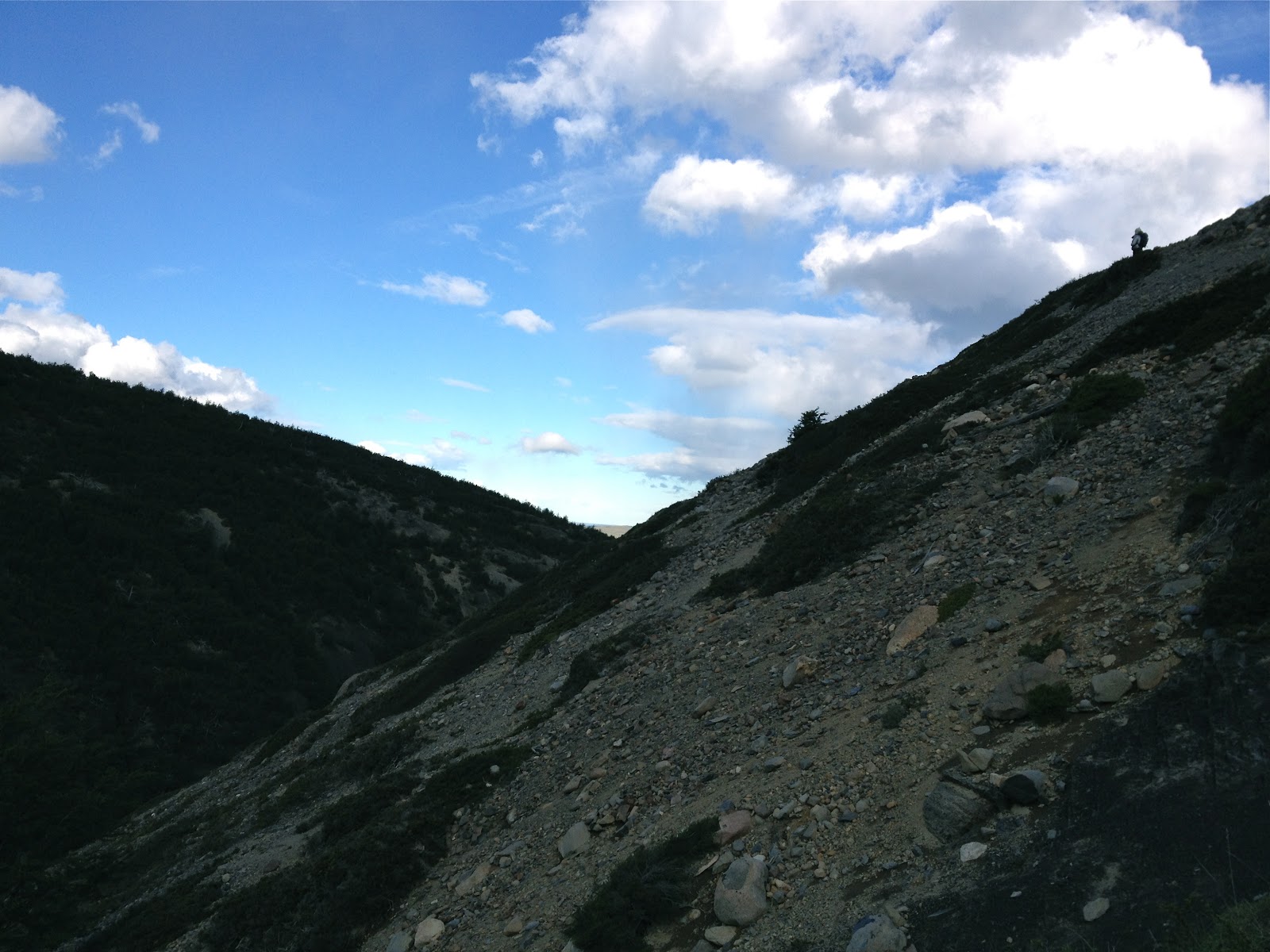
Trekking through the Torres del Paine National Park, hikers are told to expect all four seasons of weather in one day.  Torres del Paine National Park, Chile

The howling winds can completely conceal or completely reveal snow-capped peaks in a matter of seconds.  Torres del Paine National Park, Chile

Sadly, the extreme winds contributed to the spread of an accidental fire set by campers in December, 2011, which burned 36 km² of natural forest and another 128 km² of the park.  Torres del Paine National Park, Chile
Massive donations and efforts were made to reforest the park; some regrowth has occurred, but the natural habitat can never be fully restored.  Torres del Paine National Park, Chile


One valley that used to be home to many hummingbirds due to its unique shelter from the wind was destroyed in the fire, forcing the birds to look for shelter elsewhere. Torres del Paine National Park, Chile

Many bird species manage to thrive throughout the austral winter. Torres del Paine National Park, Chile
The Andean Condor, the national bird of Chile, soars above with finger-tip like wings.  As an adult, the condor can have a wingspan of up to 3.2 meters. Torres del Paine National Park, Chile
The Torres (towers) and Cuernos (horns) in Torres del Paine National Park are more jagged than the peaks of the adjacent Andes because they are younger, and have therefore been subject to less erosion. Los Cuernos, Torres del Paine National Park, Chile

Glacier Grey creeps around the corner as it sends mini icebergs into the lake. Glacier Grey, Chile

The word "paine" comes from the indigenous Tehuelche word for "blue." Torres del Paine National Park, Chile

Hikers are lucky if they reach the viewpoint of Los Torres with a clear sky to view the towers.  Torres del Paine National Park, Chile

It is general knowledge in the park that hikers can safely refill their water bottles with water from the springs.  Torres del Paine National Park, Chile
Many types of flowers bloom in springtime Patagonia, including the fragrant and bright yellow Calafate flower that yields an edible berry of the steppe.  Patagonia, Chile/Argentina


People come from all over the world to experience the natural beauty of Chile's Patagonia. It is common to see both the Chilean National flag flown together with the flag of Magellan. Torres del Paine National Park, Chile